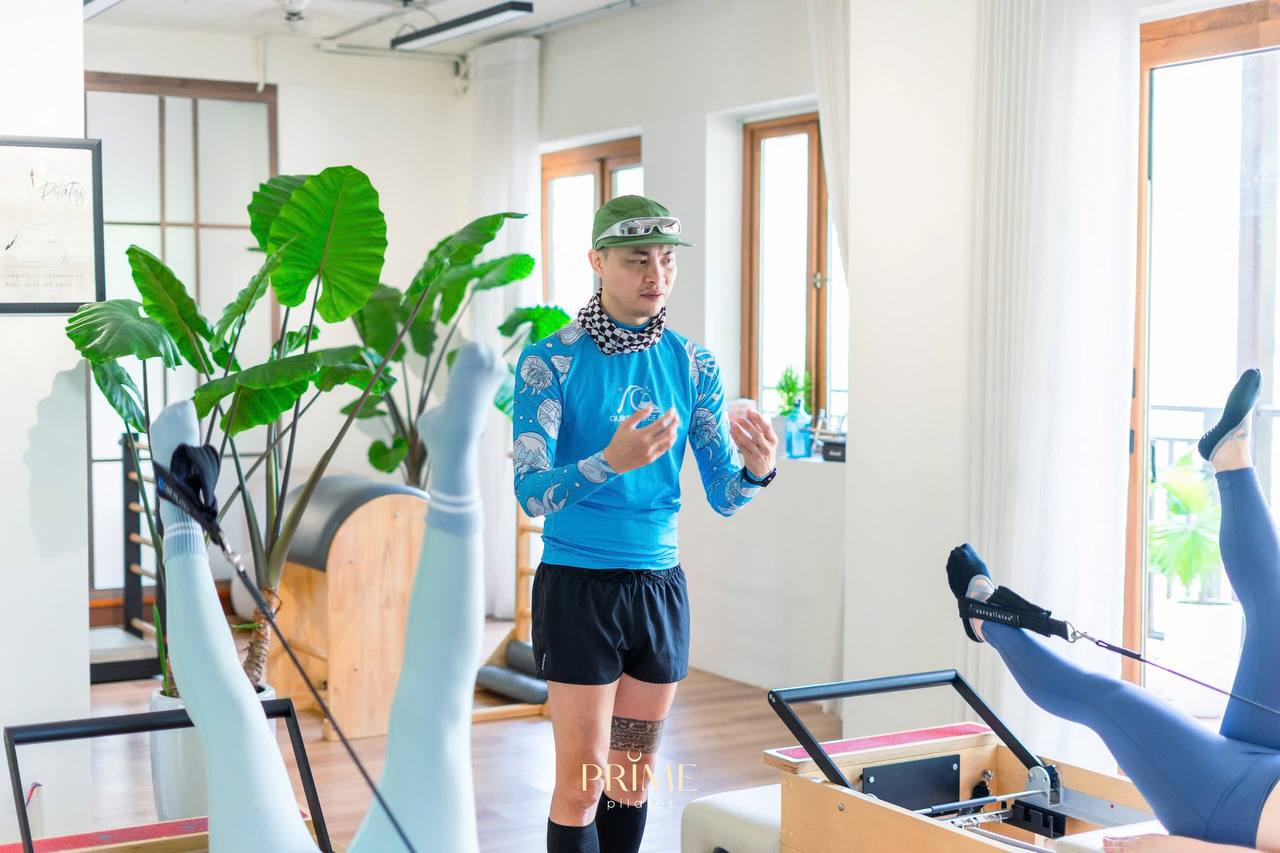
Principle: screen first, load later
A barre class can leave students trembling with fatigue — that is the point. But before letting anyone into the heavy work, I run 15 screening tests of the musculoskeletal and vascular systems. Not to diagnose — an instructor does not diagnose. To know who should hold back, who should see a doctor, and who can train normally.
The tests split into 5 groups:
| Group | Test | Area detected |
|---|---|---|
| Neck | De Kleyn · Jackson · Cervical Distraction · Adson | Vertebral artery insufficiency, cervical nerve-root impingement |
| Thoracic outlet | Wright | Thoracic outlet syndrome (pectoralis minor) |
| Shoulder & arm | Drop Sign · Finkelstein · Mill’s | Rotator-cuff tear, De Quervain, tennis elbow |
| Lower back & leg | Bragard · Maigne · Achilles · Soto-Hall | Lumbar nerve-root impingement, sacroiliac joint, Achilles tendon |
| Whole system | Valsalva · Trendelenburg | Intracranial pressure, hip abductor weakness |
The neck group is the one I take most seriously. The six signs below — any single one means stop immediately:
- Vertigo — dizziness, loss of balance, having to grip the wall
- Nausea — nausea, turning pale
- Nystagmus — eyes jerking side to side even when staring still
- Diplopia — seeing double
- Visual disturbance — blur, narrowing of the visual field
- Sensory disturbance — numbness around the mouth, pins and needles on one side of the body
These six are signs of vertebral-basilar insufficiency (VBI). The vertebral artery runs through the transverse foramina of C6→C1, then joins the basilar artery that feeds the brainstem, cerebellum and posterior brain. Excessive neck rotation can temporarily narrow that flow. No exercise is worth that trade.
De Kleyn procedure: the student lies supine, I rotate the neck + slight extension, hold 30 seconds each side, stand opposite and observe the eyes for 10 seconds after returning to centre. 15 tests × ~90 seconds ≈ 22 minutes for the whole set.
A 45-minute class structure
| Part | Content | BPM |
|---|---|---|
| Chain (warm-up) | Joint opening, activation, teaching the beat | 60–80 |
| Strength | Band, light weights, controlled tempo | 90–110 |
| Power | Short bursts, crisp cues | 115–130 |
| Core | Abdominals, back, pelvic stability | 90–110 |
| Cardio | Continuous rhythm, no break in the movement line | 115–130 |
| Cool-down | Stretching, breathing, lowering the rate | 60–80 |
Above 140 BPM is not recommended — technique collapses before the heart can benefit.
Tempo in the syllabus is written as 3 digits — lowering phase / hold / lifting phase, in seconds:
111, 121, 131, 222, 212, 232. In class we count 8 count = 1 set, 8 count × 2–4 sets =
1 block. Strength counts down: “4 more → 2 more → one more”.
Cueing: what to say and what not to say
Cues that make students stop: “At first this isn’t very good, right”, “Like climbing stairs”, “Um, hu, wow, stop”.
Cues that keep the movement line going: “Let’s hit the beat” · “Keep breathing” · “Don’t break the movement line” · “Not the legs — the rhythm!” · “Don’t hold tight, let it flow”.
Exclusion checklist during class: burning heat in one specific area → shrink the range immediately. Stopping for more than 10 seconds → drop the exercise. Tempo slowing → raise the BPM. Squatting deeper → correct to a shallower squat.
What was cut to make it run
The first plan had 5 phases, a rented private studio, 3 sample videos, a logo redesign, and a complex service package. After reviewing each item, 70% of the work was cut:
- Renting a private studio → dropped, using shared hours with the existing ecosystem (0 capex)
- Shooting sample videos → dropped, reusing real class footage already on hand
- Logo redesign → dropped, keeping “BARRE K” as is
- Multi-tier package → dropped, only drop-in and a 10-session pack remain
Exactly 3 things remain: a place to teach, one trial class, and collecting payment. Booking via form + QR payment, no cash handling. No advertising, no retail shop — just classes, real people training, and real results.
That is all it takes to run. Everything else — landing page, app, franchise — can be added later, once the class has regulars every week.
Syllabus
The technical foundation comes from carepilates® — Global Instructor Training Course (BARRE) and the Barre K book. The Strength/Power section clearly separates two things often lumped together:
- Weight Training is the means — external weights, aiming to grow muscle size, measured in kg × reps.
- Strength Training is the goal — improving force production, using body weight, bands, springs; neural adaptation and maintaining alignment are the core; it need not be heavy.
Strength parameters: heavy weights · relatively slow speed · 1–6 reps · maximal effort before peripheral fatigue.
On motor learning: LTP (Long-Term Potentiation) — repetition strengthens neural connections. So repeating correctly matters more than repeating a lot. That is why the class caps at 8 people: so each person can be corrected individually.