Gyrokinesis workshop class — students seated in rows, teacher guiding

Gyrokinesis — the missing piece for the spine that barre and Pilates leave open

Technique07/2026Da NangOctober 6, 2026

#Gyrokinesis#Movement#Workshop#Spine

A Gyrokinesis workshop in Da Nang: 35 photos documenting class structure, syllabus and how the teacher corrects each student. Three-dimensional movement, no machines.

By the numbers

How Gyrokinesis differs from Pilates and yoga

Gyrokinesis teaches three-dimensional movement: each joint is opened across the front–back, lateral and rotational planes. Unlike Pilates (emphasis on stability and control) and yoga (emphasis on holding poses), Gyrokinesis emphasises continuous flow and joint range.

A typical session is performed seated on a stool or the floor, with no machines. That is why it integrates easily into an existing studio: no large equipment investment.

Why it was added to the programme

Barre and Pilates students often share the same blind spot: the spine rotates little. Barre is strong in stability and endurance, Pilates in core control, but both can leave practitioners stiff in the rotational plane without compensation.

Gyrokinesis is that compensation — opening the hip and spinal joints along the plane the other two disciplines rarely reach.

Documenting the workshop

The workshop ran seated — the teacher demonstrates first, students follow, then the teacher moves through the class correcting each person. All 35 photos below were shot during that session, unposed.

Observable sequence: syllabus opening → seated spinal rotation → forward-fold sequence → rows of students practicing in unison → teacher correcting each person in the row.

Gyrokinesis beside the two disciplines currently taught

CriterionGyrokinesisPilatesYoga
FocusContinuous flow, joint rangeCore stability, controlHolding poses, breath
Planes of movementAll three, emphasis on rotationMainly front–back and lateralVaried but static
EquipmentStool, floorReformer, matMat, block, strap
Blind spot leftLow strength loadLow spinal rotationLow muscular endurance

No discipline replaces another — but combined, they fill each other's gaps.

How it was done

  1. Opening

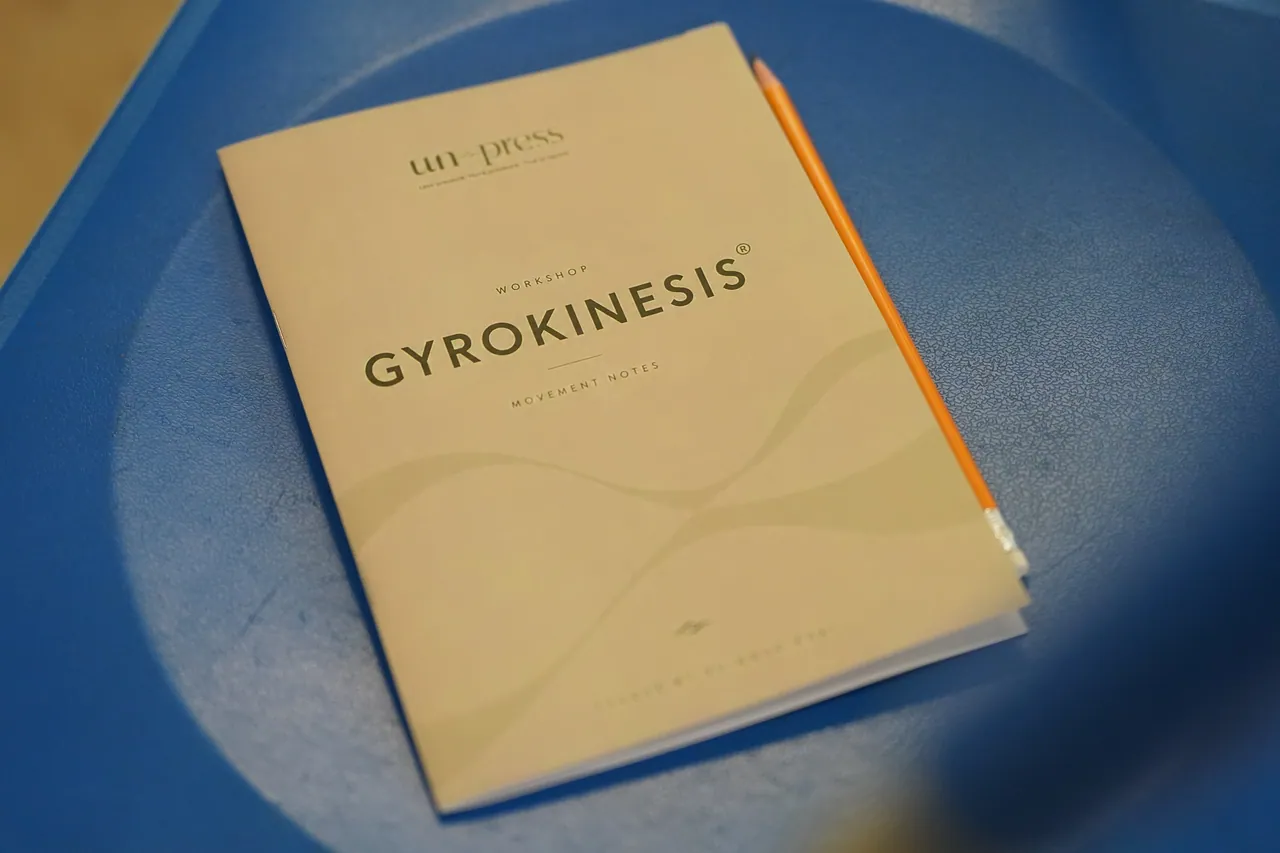
    Syllabus

    Introduction to three-dimensional movement principles and the session sequence.

  2. Warm-up

    Seated spinal rotation

    Seated on a stool, rotating and articulating the spine segment by segment.

  3. Main set

    Fold and open sequence

    Forward fold, hip opening, coordinating breath with range of motion.

  4. Correction

    Teacher moves through the class

    Students practice in unison while the teacher corrects each one individually.

Gallery

37 photos, click to enlarge

Evidence

All projects